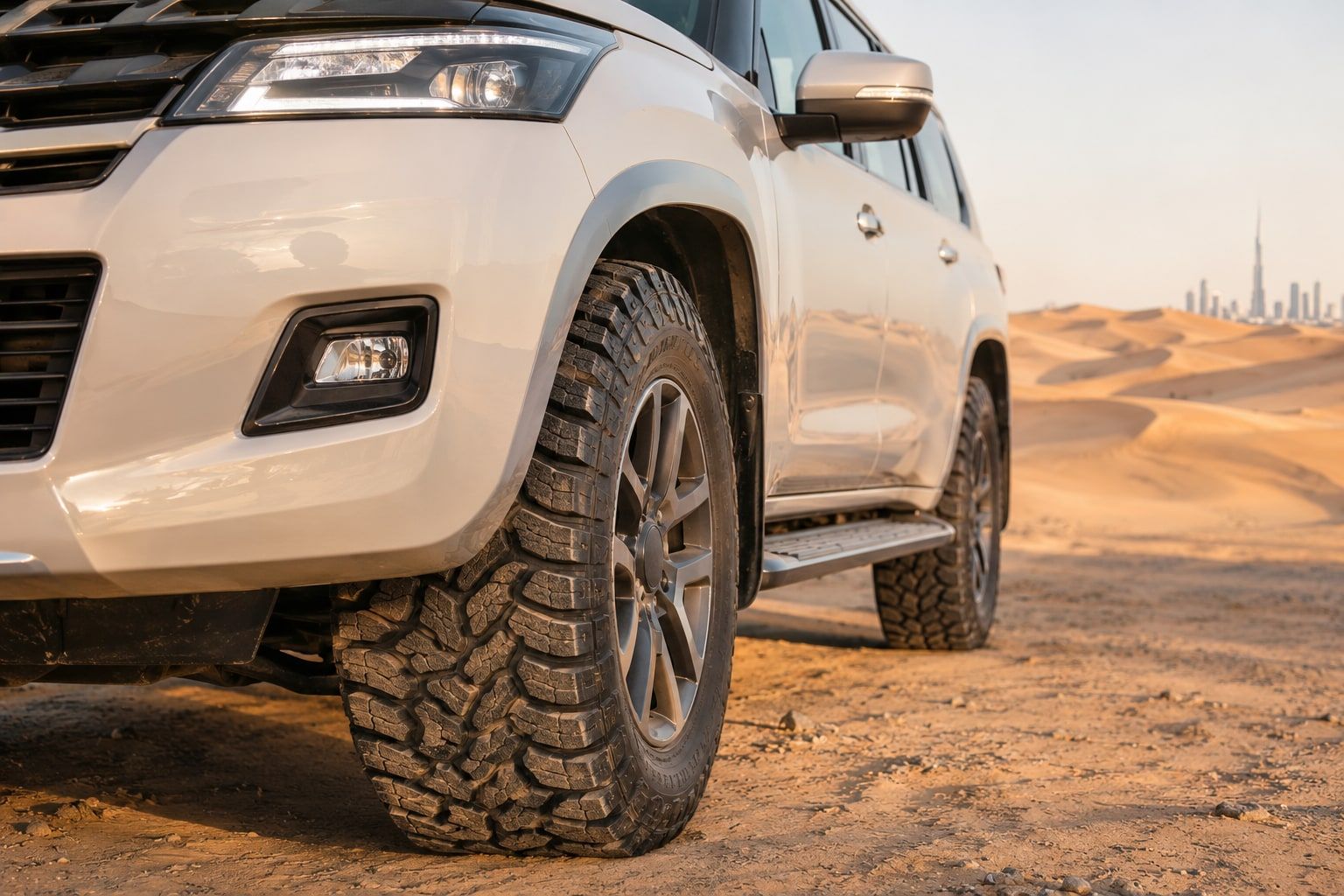
Before a long run to Abu Dhabi, Al Ain, Fujairah or Hatta, check four things with the tyres cold: pressures set to the placard (using the loaded figure if the car is full), tread depth, sidewalls free of bulges and cuts, and a spare that is inflated and in date. If the trip includes sand, carry a compressor and re-inflate to road pressure before you rejoin the tarmac.
Long, sustained motorway speed in summer is when a neglected tyre is most likely to let you down, and the hard shoulder of the E11 at midday is a poor place to discover the spare is flat.
What should you check the night before?
- Cold pressure on all four tyres, front and rear set separately
- The loaded figure from the placard if the car will be full
- Tread depth on every tyre, at the inner edge too
- Both sidewalls for bulges, cuts and cracking
- DOT dates on all five tyres, spare included
- Spare pressure, plus the jack, wheel brace and locking-nut key
- No TPMS warning on the dashboard
TyreSafe recommends checking pressures before long journeys as well as monthly. For depths, the tread depth guide shows how to read a gauge; for dates, see tyre ageing.
What pressure should a loaded family SUV run?
Use the laden figure if your placard gives one and the car is carrying a full family, luggage or a roof box. Michelin advises using the higher loaded pressure when fully loaded and going back to the standard figure afterwards.
Never inflate beyond the maximum moulded on the sidewall. If you regularly drive a Patrol, Land Cruiser or Prado fully loaded, it is worth confirming the tyres’ load index suits that use; SUV tyres covers what to look for.
How does summer heat change the routine?
Set pressures in the morning before setting off, because a warm tyre reads high. Michelin’s Middle East advice is to measure after less than 2 km of driving and never to bleed air from a hot tyre to bring it down.
At a midday fuel stop
Walk round the car and look at each tyre, but leave the pressures alone until they have cooled. A tyre that looks noticeably lower than the others is the one to investigate.
What changes on Hatta, Fujairah or Oman border runs?
| Route | Tyre focus |
|---|---|
| Dubai to Abu Dhabi on the E11 or E311 | Pressures and sidewalls for long, steady speed |
| Dubai to Al Ain | Sand on the shoulders; check tread for embedded stones |
| Hatta and Fujairah mountain roads | Tread and spare; long climbs and descents |
| Oman border trips | A sound full-size spare and tools |
Our mobile technicians and flat-tyre call-outs cover Dubai, Sharjah and Abu Dhabi. Beyond those, your spare is the plan, so check it properly; spare tyre fitting can replace an old or damaged one before you go.
How should you deflate for sand and re-inflate afterwards?
- Lower only for soft sandBFGoodrich notes most off-road driving can be done at road pressure, and a reduction helps only in low-traction conditions such as sand.
- Respect the limitsBFGoodrich says pressures below 20 psi are for off-road use only, at 25 km/h or less, and only where the tyre still has enough load capacity.
- Carry a compressor and gaugeDo not plan on driving to a fuel station on soft tyres.
- Re-inflate before the tarmacBring every tyre back to the placard figure immediately on returning to sealed roads.
Why re-inflation matters
BFGoodrich warns that driving on the highway without re-inflating seriously affects handling and can lead to tyre failure. Low pressure plus speed builds heat in the casing.
If desert trips are regular, compare all-terrain tyres with highway-terrain patterns, explained in H/T vs A/T tyres.
What if the tyres are borderline before the trip?
Replace before the trip, not after it. A tyre near 3 mm, past its five-year date or showing sidewall damage is far easier to change at home than at the roadside, far from a fitter.
Book a tyre pressure check or tyre replacement a few days ahead so there is time to source your size.
Going on a long drive? Send your car and tyre size and we will check or replace the tyres before you leave.
Questions
Questions drivers ask
Should I increase tyre pressure for a long drive?
Only to the laden figure on your placard if the car is heavily loaded. Otherwise set the normal cold pressure and check it before you leave.
What tyre pressure should I use on sand?
It depends on the vehicle, tyre and load, so follow the vehicle and tyre maker guidance. BFGoodrich says pressures under 20 psi are for off-road use at 25 km/h or less.
How soon do I need to re-inflate after the desert?
Immediately on returning to sealed roads. BFGoodrich warns that highway driving on reduced pressures can cause tyre failure.
Does the spare tyre need checking before a road trip?
Yes. Check its pressure and DOT date; NHTSA advises including the spare in monthly pressure checks, and Dubai’s RTA treats tyres more than five years from manufacture as expired.
Sources
- TyreSafe: the tyre checks (tread, pressure, condition)
- Michelin USA: what tyre pressure to use, including loaded pressure
- Michelin Middle East: how to check tyre pressure
- BFGoodrich Australia: tyre pressure FAQ (off-road and sand)
- NHTSA: tyres and tyre safety
- Dubai Media Office: RTA tyre inspection campaign