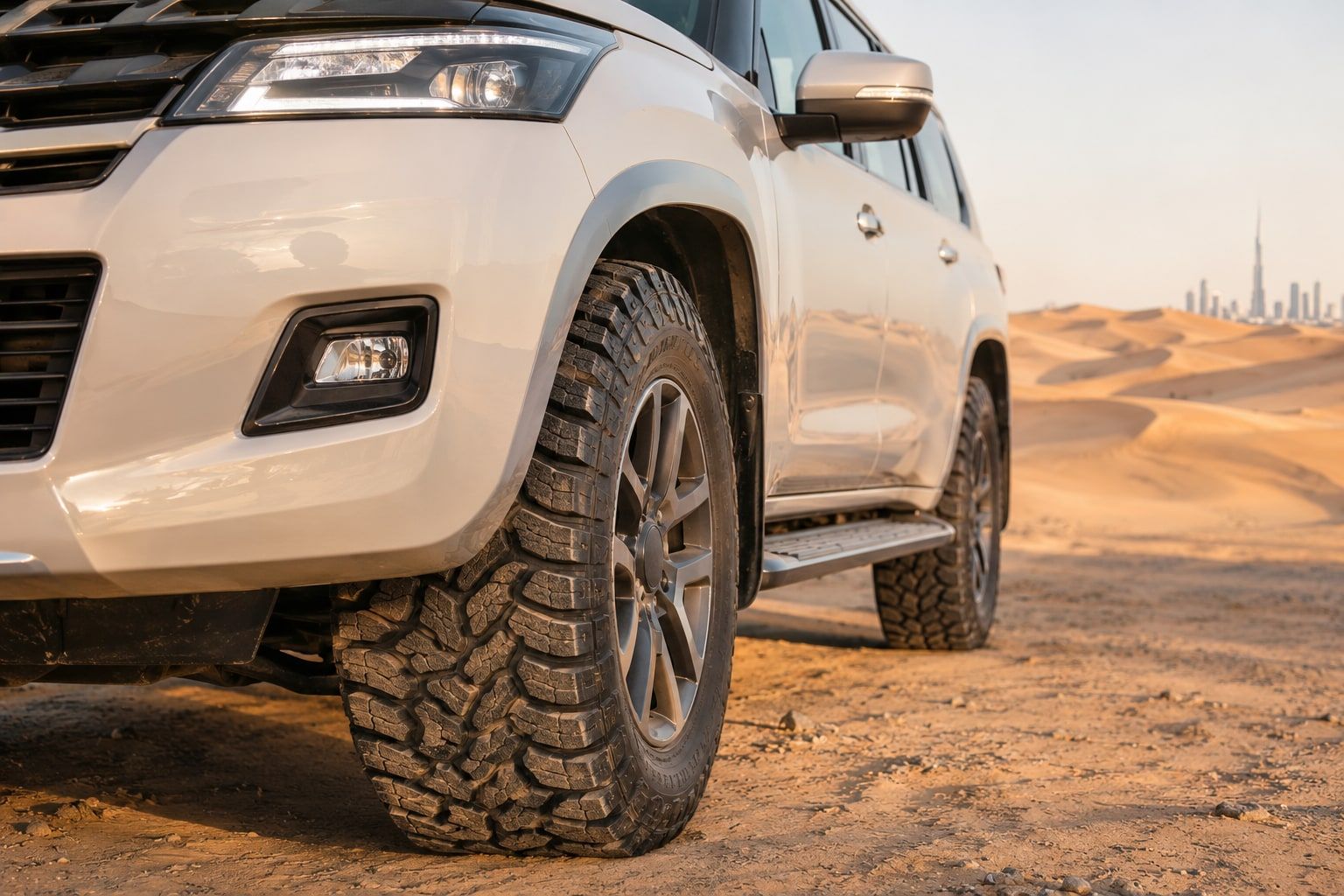
Choose highway-terrain (H/T) tyres if your SUV spends nearly all its time on tarmac, and all-terrain (A/T) tyres if you head into the dunes, wadis or graded tracks more than a handful of times a season. H/T tyres ride more quietly and usually use less fuel; A/T tyres give some of that up for deeper, wider-grooved tread and tougher compounds that resist chips and cuts off-road.
This post compares the two on UAE roads and sand, looks at the big SUVs we fit most, and finishes with a verdict for each type of owner.
How are H/T and A/T tyres built differently?
The difference is in the tread and the compound. Bridgestone says all-terrain tyres usually have deeper tread, wider grooves and larger tread blocks than highway tyres, with compounds designed to resist chipping and tearing on rough ground.
Highway-terrain (H/T)
- Tighter, quieter tread pattern
- Smoother ride on tarmac
- Better fuel economy
- Long tread life on motorway use
- Limited grip in soft sand or loose gravel
All-terrain (A/T)
- Deeper, open tread with bigger blocks
- Cut- and chip-resistant compound
- More grip on gravel, tracks and sand
- More road noise
- Slightly higher fuel use
There is a third option beyond A/T. Mud-terrain tyres go further off-road but are louder and wear faster on tarmac, so they rarely make sense for a UAE SUV that commutes in the week.
What changes on the motorway?
On the motorway an H/T tyre is quieter, rides better and uses less fuel. Bridgestone lists ride comfort, low road noise, long wear and better fuel economy as the strengths of highway tyres compared with all-terrain ones.
The gap has narrowed. Continental notes that many modern all-terrain models offer their off-road ability without giving up on-road comfort, and a current A/T pattern is far more civil than the chunky tyres of a decade ago. A daily run on Sheikh Mohammed Bin Zayed Road will still be noticeably quieter on a highway tyre, though.
Tread life is the other motorway factor. Bridgestone lists long wear among the strengths of highway patterns, which counts on an SUV that covers big distances on the E11 and rarely sees sand.
What changes in the sand and on gravel?
In sand and on gravel the A/T tyre’s open tread and tougher compound make the difference. The extra groove volume helps the tyre clean itself, and the compound copes better with the sharp stones found on wadi tracks and the gravel shoulders around Hatta and Jebel Jais.
Technique matters as much as the tyre. Most experienced desert drivers lower pressures for soft sand and carry a compressor to restore the placard pressure before rejoining tarmac. A common case at the fitting bay is an H/T tyre with a cut or torn shoulder after a single trip over rocky ground, which an A/T casing is designed to resist.
Always restore the placard cold pressure before driving at motorway speed, because that is the pressure the car and tyre are set up for on the road. Our tyre pressure guide explains how to set it.
BFGoodrich’s own off-road guide makes the same point from the other direction: if most of your driving is on the road with occasional trails, an all-terrain tyre is a better fit than a mud-terrain one. Heavier off-road use is covered in our off-road and 4x4 tyres guide, listed below.
Which suits a Land Cruiser, Patrol or Prado?
It depends on how often the car leaves tarmac, not on the badge. Large SUVs such as the Land Cruiser, Patrol and Prado are bought for both school runs and desert weekends, so owners split almost evenly between the two types.
| Owner profile | Better choice |
|---|---|
| City and motorway only | H/T |
| A few desert trips a year | H/T or a road-biased A/T |
| Regular dunes or wadis | A/T |
| Heavy towing or rocky tracks | A/T with a high load index |
Whichever you pick, match the load index on the placard, because these SUVs are heavy before passengers and kit go in. Representative examples include the Bridgestone Dueler A/T and the BFGoodrich All-Terrain T/A for off-road use, and highway patterns from most premium makers. Check your size on our Toyota fitment guide or the tyres by car finder.
How much are SUV tyres?
SUV tyre prices depend on rim size, load index, pattern type and brand, so a quote for your exact size is the only reliable figure. A/T versions of a size can be priced differently from H/T ones, and larger 20-inch fitments generally cost more than 17 or 18-inch ones. Ask for both patterns in your size before deciding, since the gap between them varies by brand.
Fitting a set of four at once keeps the handling even, which matters on 4x4 systems. See what affects the fitted cost of a tyre for the full list, and our SUV tyres guide for the rest of the buying decision.
Our verdict: H/T or A/T?
Fit H/T if your SUV is a family car that sees sand only when parked at the beach. Fit A/T if you drive off-road regularly, or if sidewall cuts from rocky tracks have already cost you a tyre.
If you are in between, a road-biased A/T is the honest compromise: a little more noise for real off-road confidence. Compare both on our highway-terrain and all-terrain pages, then send us your size.
Send your SUV, tyre size and how often you go off-road and we will quote H/T and A/T options.
Questions
Questions drivers ask
Are all-terrain tyres noisy on the motorway?
They are usually louder than highway tyres because of their open tread and bigger blocks. Modern A/T patterns are much quieter than older designs, but a highway tyre will still be the quieter option at motorway speed.
Do all-terrain tyres use more fuel?
Generally yes, slightly. Bridgestone notes that highway tyres typically get better fuel economy than all-terrain ones. The difference depends on the pattern and size.
Can I drive in the desert on highway tyres?
On firm sand and graded tracks, with lowered pressures and care, many drivers do. H/T tyres have less grip in soft sand and are more vulnerable to cuts on rocky ground, so regular off-road use calls for A/T.
How much are SUV tyres in the UAE?
It depends on size, rim diameter, load index, pattern and brand tier. Send us your size and we will quote highway and all-terrain options so you can compare.
Sources