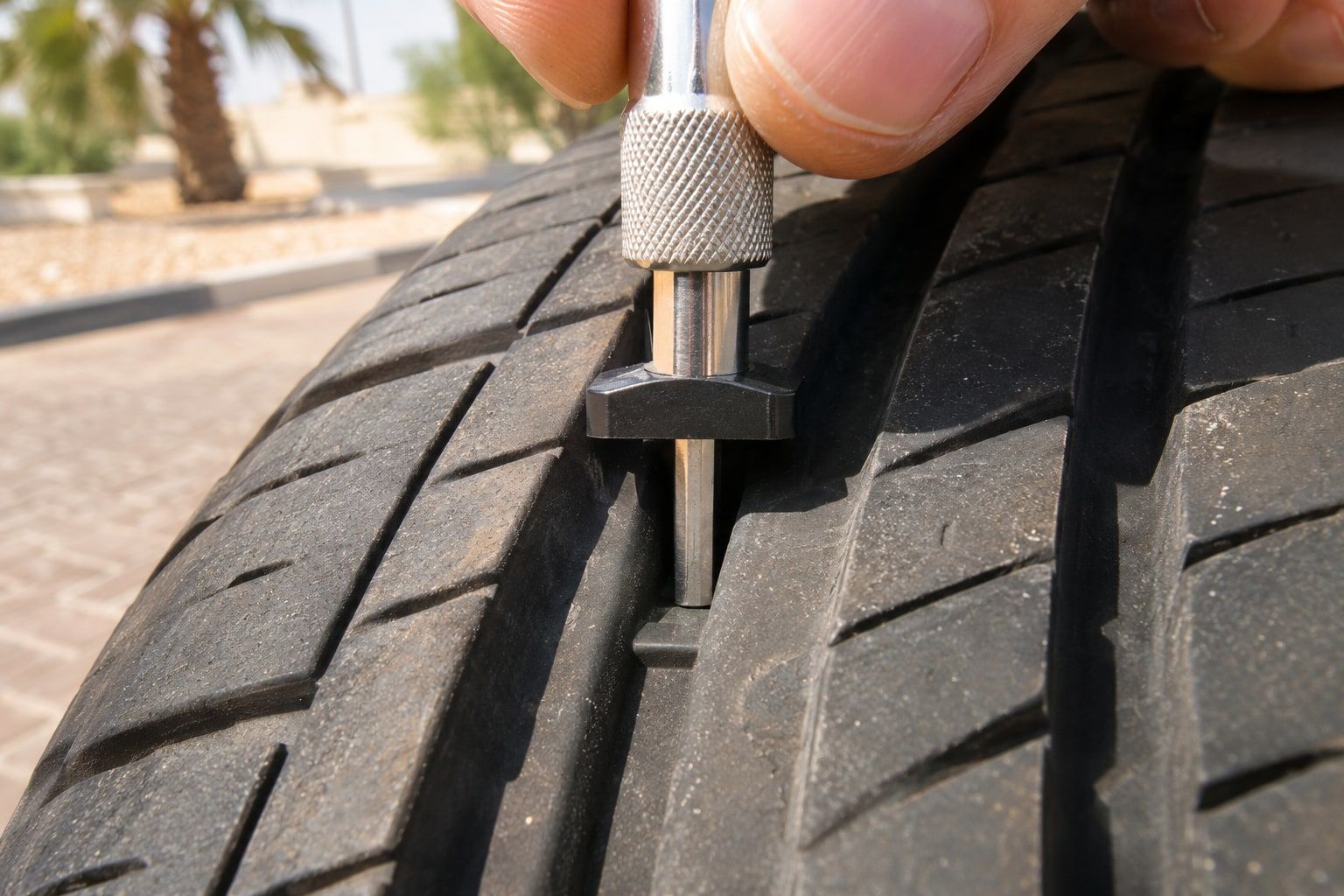
The legal minimum tyre tread depth in the UAE is commonly given as 1.6 mm, which is also the height of the tread wear indicator bars moulded into the main grooves. Tyre-safety groups advise replacing sooner: TyreSafe suggests considering new tyres once tread falls below 3 mm. A cheap tread depth gauge is the most reliable way to know where you stand.
Tread is what clears water from under the tyre in a sudden winter downpour. Tread depth also decides whether a tyre is still worth repairing after a puncture.
What do 8 mm, 3 mm and 1.6 mm actually mean?
| Depth | What it means |
|---|---|
| New tyre | Full depth varies by model; check the maker’s data |
| 3 mm | Point where TyreSafe suggests considering replacement |
| 1.6 mm | Legal minimum; level with the wear bars |
| Below 1.6 mm | Replace; Continental says grip is lost |
Michelin’s Middle East guidance applies the 1.6 mm minimum across the central three-quarters of the tread, all the way round. A tyre that is legal in one groove and bald in another is judged on the worst groove.
How do you check tread depth at home?
Depth gauge
- Most accurate
- Push the probe into a main groove
- Read the lowest of several spots
Wear bars (TWI)
- Raised ribs inside the main grooves
- Flush with the tread means replace
- Michelin marks them with a small Bibendum on the sidewall
Coin test
- Used in the UK (20p) and US (penny)
- Only a rough legal-limit check
- UAE coins are not a calibrated guide
Continental’s method is to press the gauge’s shoulders flat against the tread, read the probe, and judge the tyre by the lowest figure you find. Check inner, centre and outer grooves at three or four points around each tyre.
Why does one part of the tyre wear faster than another?
Different readings across the same tyre point to a cause rather than normal wear. Low edges suggest soft pressures, a worn centre suggests too much pressure, and one bald edge points to alignment.
The uneven tyre wear guide shows each pattern, and if the inner edge is the low one, read alignment symptoms before buying replacements.
When should you replace rather than wait for 1.6 mm?
- Tread is near 3 mm and the car does long motorway runs.
- A heavy SUV or family car often travels fully loaded.
- The tyre also passes five years from its DOT date: see tyre ageing.
- The tyre has a puncture: Michelin advises against repairing a tyre worn to the legal limit.
- The partner tyre on the same axle is being replaced anyway.
The when to replace tyres post covers the full decision. To see what fits, search tyres by car or tyres by size, then book tyre replacement.
Send your tyre size and tread readings and we will quote replacements for your car.
Questions
Questions drivers ask
What is the legal tread depth in the UAE?
It is commonly given as 1.6 mm, matching the height of the tread wear indicators. Many safety groups recommend replacing before that, nearer 3 mm.
How often should I check tread depth?
NHTSA suggests checking tread at the same time as your monthly pressure check. It takes a couple of minutes with a gauge.
Should I replace two tyres or all four?
Replace at least the axle pair, so both sides grip the same. On all-wheel-drive cars the handbook may require all four to keep diameters matched.
Can I repair a puncture in a worn tyre?
Michelin’s guidance is that a tyre at or below the legal wear limit should be replaced, not repaired. Near the limit, a new tyre is usually the better spend.
Sources