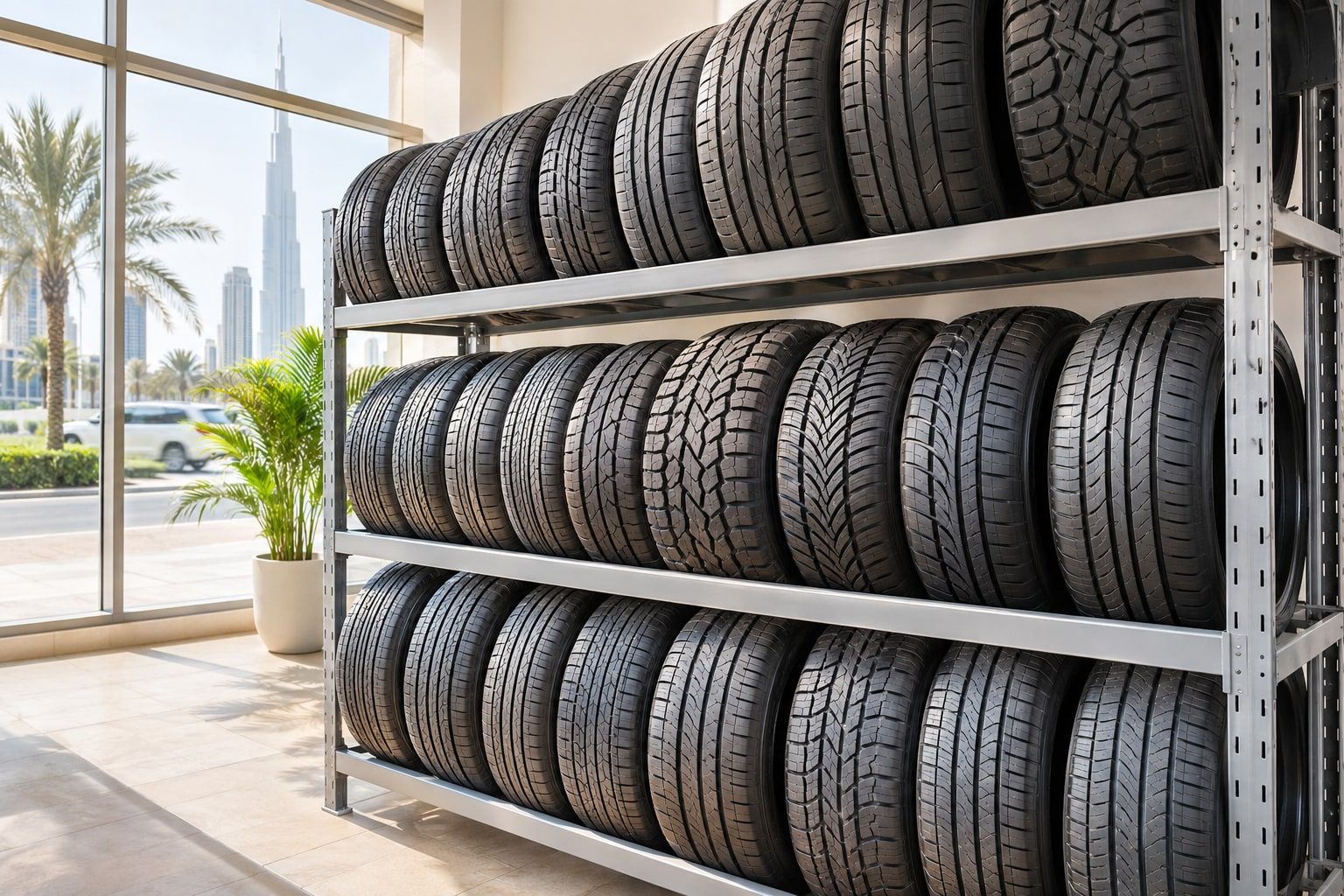
For most UAE drivers who spend the week on Sheikh Zayed Road and city streets, a touring tyre is the better buy: it rides more quietly, wears more slowly and still grips well in the heat. Performance tyres earn their place when the car left the factory on V, W or Y-rated rubber, or when sharp steering and maximum grip matter more to you than tread life and a calm cabin.
This post sets out the trade-offs a fitter weighs when a driver asks which of the two to buy. It covers how the tyres are built, how they behave on UAE roads, which cars should stay on performance tyres, and a straight verdict at the end.
What is the real difference between touring and performance tyres?
The difference is what each tyre is optimised for. Continental describes touring tyres as built for long-distance driving with comfort, low noise and durability, while performance tyres give improved grip and quicker, more responsive handling at some cost to ride comfort, tread life and fuel efficiency.
Touring
- Softer, more compliant ride over joints and speed bumps
- Lower road noise at a steady cruise
- Harder-wearing compound for longer tread life
- Usually lower speed ratings such as T, H or V
Performance
- Sharper turn-in and steering feel
- Higher dry and wet grip limits
- Firmer ride and more road noise
- Softer compound that wears faster; usually V, W or Y rated
Michelin puts the performance trade-off plainly: a firmer ride, more road noise and faster tread wear compared with touring tyres. Neither is the better tyre in the abstract. The right one is the tyre whose compromises you notice least in your own driving. Our tyre performance guide explains each of those qualities in more depth.
How do the trade-offs show up on UAE roads?
On UAE roads the trade-offs show up mainly as noise, wear and ride on long, straight motorway runs. A daily commute from Dubai Marina to Downtown, or a weekly drive to Abu Dhabi on the E11, is mostly steady cruising, which is exactly where a touring tyre’s quieter pattern and longer-wearing compound pay off.
Michelin notes that softer performance compounds wear faster, and that the more aggressive a tread design looks, the more likely it is to generate noise. A common case at the fitting bay is a driver who moved from a sports-focused tyre to a touring pattern on a family saloon and mainly noticed the cabin getting quieter at motorway speed. The opposite case is just as common: an owner of a powerful coupe who fitted a touring tyre to save money and found the steering felt vague.
Summer heat cuts both ways. A performance compound is designed to work warm, so it does not lose its grip advantage in a UAE summer, but hot road surfaces and long distances still use up its tread sooner. Keep pressures at the placard figure, checked cold in the morning, using our tyre pressure guide.
Which cars should stay on performance tyres?
Cars that were engineered around performance tyres should stay on them. Michelin points out that a vehicle supplied with V, W or Y speed-rated tyres was set up around performance-grade rubber, and that fitting a lower-rated touring tyre can make it feel softer and less responsive.
- Sports saloons, hot hatches and coupes with low-profile tyres on 18-inch rims or larger
- Powerful SUVs, such as performance versions of the Range Rover Sport, Porsche Cayenne or Mercedes GLE, where the speed rating on the placard is W or Y
- Cars with different tyre sizes front and rear, which usually point to a performance setup
- Any car whose placard lists a speed rating that touring ranges in your size do not offer
The rule that never bends is the speed rating and load index. Replacements must meet or exceed what the car maker specifies, which we explain in load index and speed rating explained. If a touring tyre in your size carries the right rating, it is a legitimate choice even on a sporty car, as long as you accept the softer feel.
There is a middle ground
Many makers sell grand-touring or sport-touring patterns that sit between the two, keeping most of the quietness with sharper steering. For example the Michelin Primacy range leans towards comfort, while the Pilot Sport range leans towards grip. Browse touring tyres and performance tyres to see where each pattern sits.
Can treadwear ratings help you compare the two?
Treadwear ratings help, but only within one brand and category. The UTQG treadwear number moulded on many sidewalls is a relative index: Michelin says a tyre rated 400 should last roughly twice as long as one rated 200 under controlled test conditions.
Michelin also notes that high-performance summer tyres typically sit in the 200 to 300 range, while touring tyres can reach 700 or more. That gap tells you a lot about the trade-off you are buying. It does not tell you how many kilometres you will get on UAE roads, because driving style, alignment, pressure and heat change the answer far more than the number does.
Our verdict: touring or performance?
Choose touring unless your car’s specification or your driving gives you a clear reason not to. For a Camry, Accord, Altima, Sonata or most crossovers used for school runs and motorway commuting, a good touring tyre is quieter, lasts longer and is easier to live with.
| How you drive | Better choice | Why |
|---|---|---|
| Daily motorway commute | Touring | Quieter cruise, longer wear |
| City driving, speed bumps | Touring | More forgiving ride |
| Sports car, W or Y on placard | Performance | Matches the car’s setup |
| Spirited weekend drives | Performance or sport-touring | Steering precision |
If you cannot decide, send us your car, size and how you drive and we will suggest two or three patterns in your size, with the trade-offs spelt out. We can then fit them at home or at the workshop through our new tyres service.
Send your car and tyre size and we will suggest touring and performance options that fit it.
Questions
Questions drivers ask
Are touring tyres the same as all-season tyres?
No. Touring describes what a tyre is optimised for, which is comfort, low noise and long tread life, while all-season describes the weather and temperatures it is designed to handle. Many touring tyres sold in America are also all-season tyres, which is where the confusion comes from. Snow grip is irrelevant on UAE roads, so focus on size, load, speed rating and the comfort or grip balance you want.
Do performance tyres wear out faster?
Usually, yes. Their softer compounds trade tread life for grip, and Michelin notes that high-performance summer tyres commonly carry much lower treadwear ratings than touring tyres. How hard you drive and how well the car is aligned make a big difference too.
Can I fit touring tyres on a car that came with performance tyres?
You can if the touring tyre is the correct size and meets or exceeds the load index and speed rating on the placard. Expect a softer, quieter drive with less precise steering. If no touring tyre in your size carries the required speed rating, stay with a performance or sport-touring pattern.
Are performance tyres noisier on the motorway?
Generally they are, because their tread patterns and stiffer construction transmit more road noise into the cabin. The difference varies by pattern, so compare the EU noise figure where one is published. Our guide to quiet tyres for motorway driving covers this in detail.
Sources