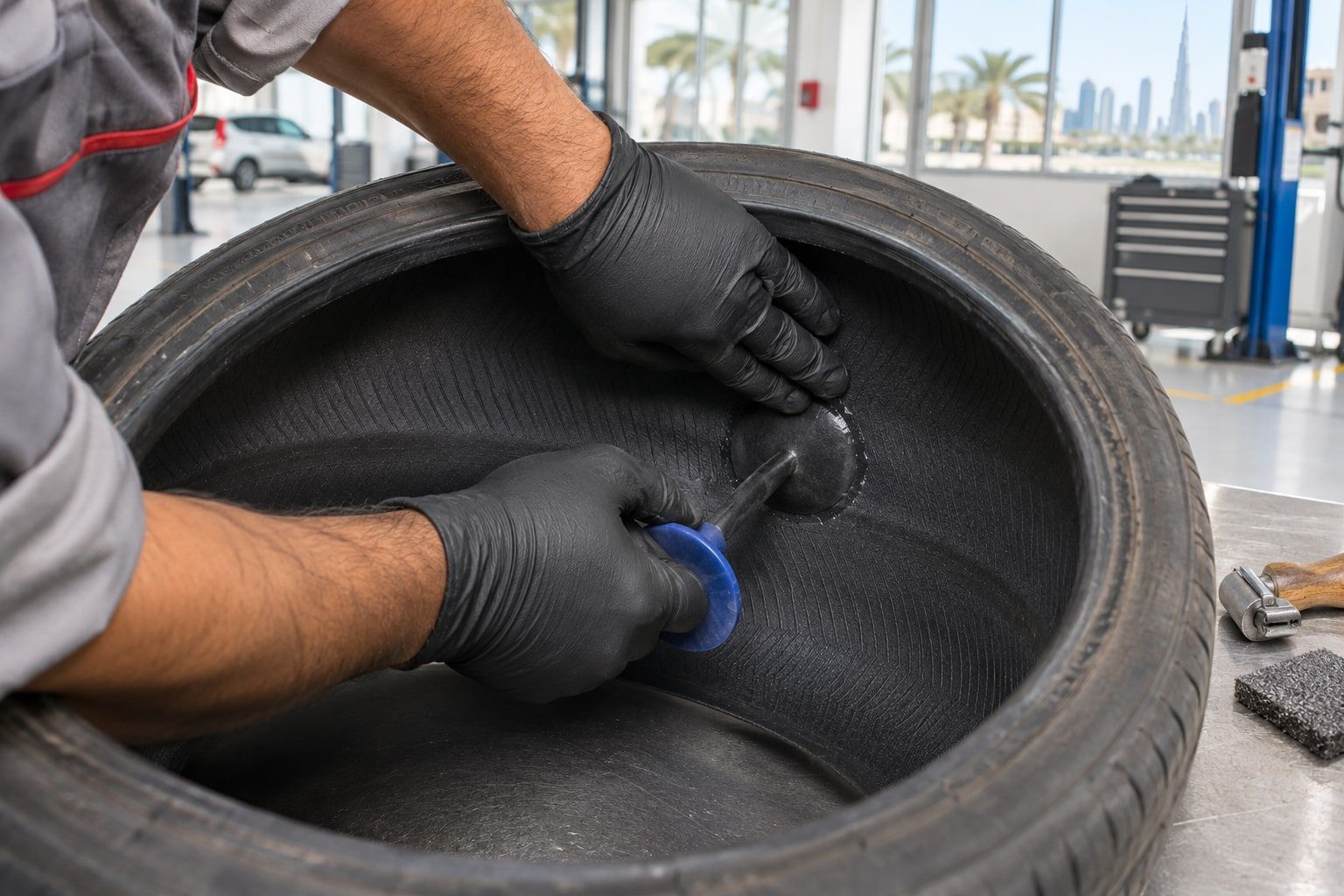
Most punctures can be repaired properly if the hole sits in the central tread, is no wider than about 6 mm, and the tyre was not driven while flat. A hole in the shoulder or sidewall, or any tyre that has been run flat, needs replacing instead. This page shows how to spot a slow leak, how to judge where the damage sits, and what the decision looks like afterwards.
A repair only counts as permanent when the tyre comes off the rim, is inspected from the inside and receives a combined plug-and-patch. A string plug pushed in from outside, or sealant from a kit, gets you to a fitter; it is not the fix.
What are the signs of a puncture or slow leak?
A slow leak usually shows up as one tyre that needs air more often than the other three. Look and listen for these signs, and check the suspect tyre with a gauge rather than by eye.
- A nail, screw or sharp stone lodged in a tread groove
- One tyre bulging slightly at the base compared with the others when parked
- The TPMS warning light, or one corner reading lower than the rest on the dashboard
- Topping up the same tyre every week or two
- A faint hiss when parked, or bubbles when soapy water is sprayed over the tread
- A rhythmic ticking at low speed, often a nail head touching the road
- Heavier steering, or a soft, wallowing feel through roundabouts
Under US rules the TPMS light is designed to come on once a tyre is about 25% below its placard pressure, so it is a late warning, not an early one. A monthly check with a gauge catches a slow leak far sooner; the tyre pressure guide explains where your car’s figure is printed.
Which part of the tyre can be repaired?
Only the central tread area can take a lasting repair, because the steel belts underneath support the patch. The shoulder and sidewall flex with every revolution, so a repair there will not hold.
| Where the hole is | Repairable? | Why |
|---|---|---|
| Central tread, up to about 6 mm | Usually | Belts back up a plug-and-patch |
| Shoulder | No | Flexes too much for a patch |
| Sidewall | No | Carries load and flexes constantly |
| Anywhere, after running flat | No | Hidden damage inside the casing |
Michelin’s Middle East guidance explains why the last row matters: driving on a tyre at very low pressure can crumble the inner rubber or shift the bead, and once the casing is damaged the tyre cannot be repaired even if the nail went into the tread.
Is it safe to keep driving on a punctured tyre?
If the object is still in the tread and the pressure is holding, a short, gentle drive to a fitter is normally fine; leave the nail where it is, because it is partly sealing the hole. If the tyre is visibly low, losing air quickly or making a flapping noise, stop somewhere safe and do not drive on it.
Stop and get help if
the tyre looks flat, the steering pulls hard, you hear flapping or rumbling, or the TPMS shows a fast drop. A few hundred metres on a flat tyre can turn a cheap repair into a replacement. Book flat tyre assistance (call-outs run 24/7) or have the spare fitted where you are.
When does a puncture need a professional inspection?
Book an inspection for every puncture
Even a tidy-looking hole needs the tyre off the rim, because inner-liner damage cannot be seen from outside. That inspection is what decides between a repair and a replacement.
- DemountThe tyre comes off the wheel so the inside can be examined.
- InspectThe technician measures the injury, checks its position and looks for rubbing or creasing from low-pressure running.
- Repair or refuseA qualifying hole gets a combined plug-and-patch fitted from inside. Anything outside the limits is refused and you get replacement options.
- RefitThe tyre is remounted, balanced and set to the cold pressure on your door placard.
You can book a puncture repair as a mobile job or at a workshop; send a photo of the tread around the hole on WhatsApp and we will tell you whether it looks repairable before we arrive.
Repair, replace one tyre, or replace a pair?
Repair
- Hole in the central tread, about 6 mm or smaller
- Tyre not driven flat
- Plenty of tread left
Replace one tyre
- Hole in the shoulder or sidewall, or too large
- Other tyre on the axle has similar tread
- Same size, load and speed rating fitted
Replace the pair
- Other tyre on the axle is well worn
- Model no longer matches the opposite side
- AWD car with tight tread-difference rules
Michelin advises against repairing a tyre already worn to the legal limit, so a puncture in an old tyre is often the moment to replace. Our tyre replacement page covers matching size and rating, and the tyres by size finder shows options for the size on your sidewall. Run-flat tyres follow their own maker rules, which differ between brands: see run-flat tyres before ordering.
Send a photo of the puncture and your tyre size and we will tell you if it is a repair or a replacement.
Questions
Questions drivers ask
How big a puncture can be repaired?
Tyre-maker guidance commonly caps a repairable injury at about 6 mm (¼ inch) across, and only in the central tread. Anything larger, or anything in the shoulder or sidewall, needs a new tyre.
Is a plug from a repair kit a permanent fix?
No. A plug pushed in from outside seals the hole but nobody has checked the inside of the tyre. Treat it as a way to reach a fitter, then have the tyre demounted and given a plug-and-patch.
Can a run-flat tyre be repaired after a puncture?
It depends on the maker. Michelin’s US guidance says damaged run-flats should be replaced, while its Middle East page allows one repair on some run-flat types, so the technician checks the specific brand and how far it was driven deflated.
Why does my tyre lose air but I cannot find a nail?
Slow leaks also come from a corroded rim bead seat, a perished valve or a bent rim lip. A technician will dunk-test the wheel to find the source, which may point to a new valve or a rim repair instead of tyre work.
Sources