Tyre service
Tyre rotation: patterns, limits and intervals
Whether your tyres can be rotated, which pattern suits your car and how often to do it.
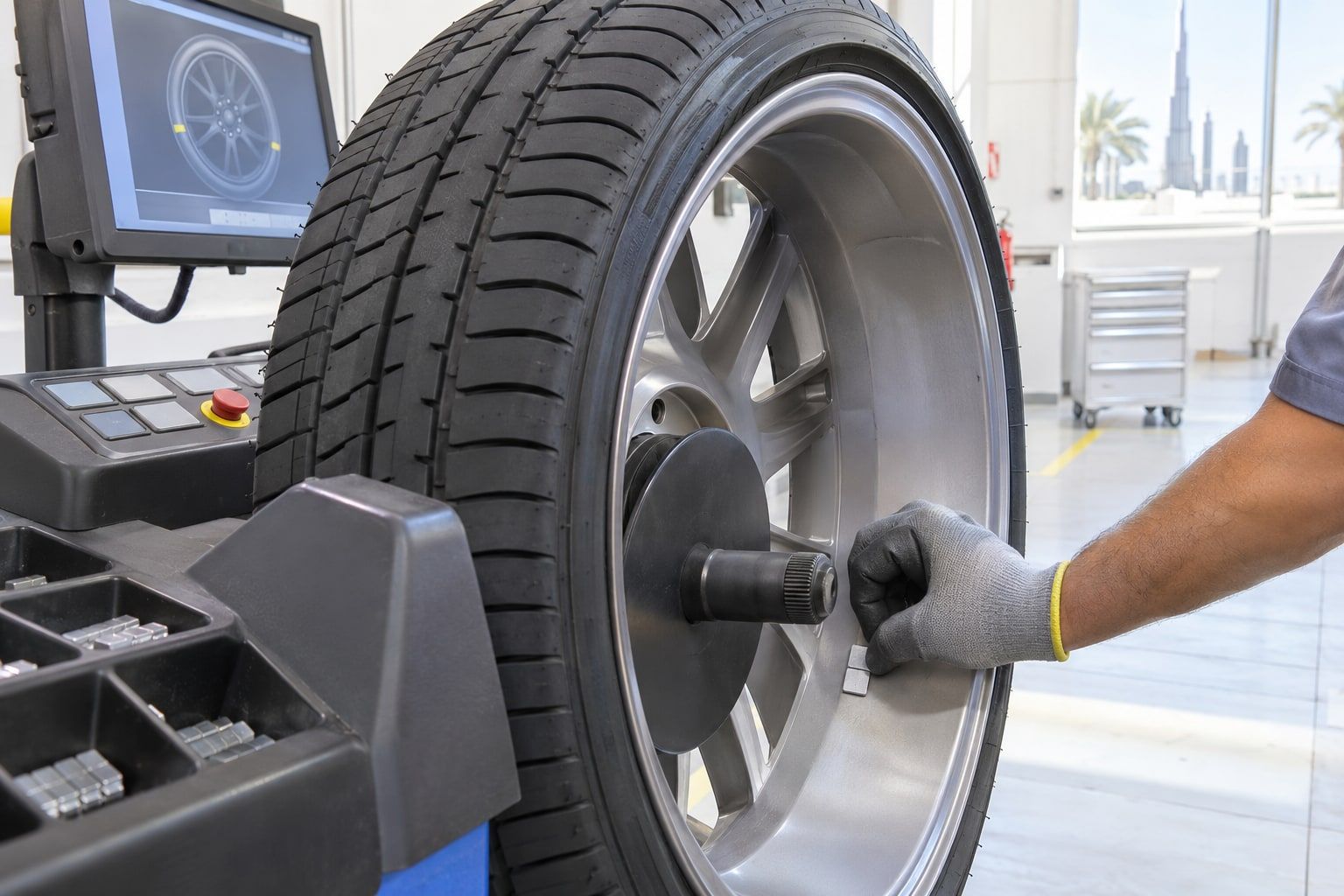
Tyre rotation moves each tyre to a different position so all four wear at a similar rate; Michelin suggests roughly every 8,000 to 10,000 km, or the interval in your handbook if it differs. The pattern depends on your drivetrain, and directional or staggered tyres limit which moves are possible.
We rotate at your location or at a workshop, check tread and pressures on each tyre, and rebalance where needed.
When you need it
- At the handbook interval, or around every 8,000 to 10,000 km
- Front and rear tread depths are drifting apart
- Before a long trip, to even out wear
- When a full-size spare is joining the rotation
Where the work happens
At your home or office anywhere we cover in Dubai, Sharjah and Abu Dhabi, or at a workshop (Al Quoz workshop, Sharjah workshop, Mussafah workshop).
Rotated by a mobile technician at your location or at our Al Quoz, Sharjah Industrial Area 10 or Mussafah workshop.
Which rotation pattern suits your car?
| Drivetrain | Common pattern |
|---|---|
| Front-wheel drive | Forward cross |
| Rear-wheel drive | Rearward cross |
| AWD and 4x4 | Rearward cross or X, per handbook |
| Directional tyres | Front-to-rear, same side |
Your handbook's pattern overrides the general rule. The rotation guide walks through each pattern in detail.
When can tyres not be rotated freely?
Directional tyres can only roll one way, so Michelin says they move front to rear on the same side. Cars with different front and rear sizes, common on BMW, Mercedes-Benz and performance cars, cannot swap axles at all.
- Directional: front-to-rear on the same side only
- Staggered sizes: side-to-side only, and only if the tyres are not directional
- Staggered and directional: no rotation; the tyres wear in place
- Full-size spare: can join a five-tyre rotation if it matches
On staggered cars, rear tyres often wear out first. Our post on replacing tyres on AWD and 4x4 cars explains why mismatched tread depth matters more on some drivetrains.
How often should you rotate tyres in the UAE?
Use the handbook interval, or around 8,000 to 10,000 km where none is given, and sooner if wear is uneven. Long, hot motorway runs and heavy SUVs wear front shoulders quickly, so a check at every oil service is a sensible habit.
If one axle is already far more worn, rotation will not even it out; read when to replace tyres and check your size on tyres by size or your model on tyres by car.
Book a tyre rotation at home or at a workshop
What the technician checks
- Tread depth on each tyre before moving it
- Directional arrows and staggered sizes
- Uneven wear that points to alignment or pressure
- Pressures reset for the new front and rear positions
What the job includes
- Moving the tyres to the pattern your car allows
- Setting placard pressures for each axle
- Balancing where a vibration or weight loss is found
- Torquing wheel nuts to the maker figure
What changes the cost
We quote after you send the details, with each part listed separately. These are the things that move the figure:
- Whether rebalancing is needed
- Four- or five-tyre rotation
- TPMS relearn on cars that need one
- Mobile visit or workshop
How to book
- Send the detailsWhatsApp or call +971 50 834 3096 with your car (make, model, year), the tyre size or a sidewall photo, and a location pin.
- Get the optionsWe reply with what the job involves, the choices that fit, and whether it is done at your location or a workshop.
- Confirm a timeWe confirm an arrival window when you book. Pay by Tabby, Tamara, Cash or Card.
Questions
Questions drivers ask
Does rotation need balancing?
It is a good time to rebalance, and Goodyear lists rotation as one of the occasions for it. We check balance if a vibration appears afterwards.
Can I rotate tyres on a Tesla or other EV?
Yes, if front and rear sizes match. Heavy EVs often wear tyres quickly, so following the handbook interval matters; staggered EV fitments cannot swap axles.
Will rotation fix uneven wear?
It spreads wear but does not fix the cause. One-sided wear points to alignment or pressure, which is worth checking before the tyres are moved.
Sources