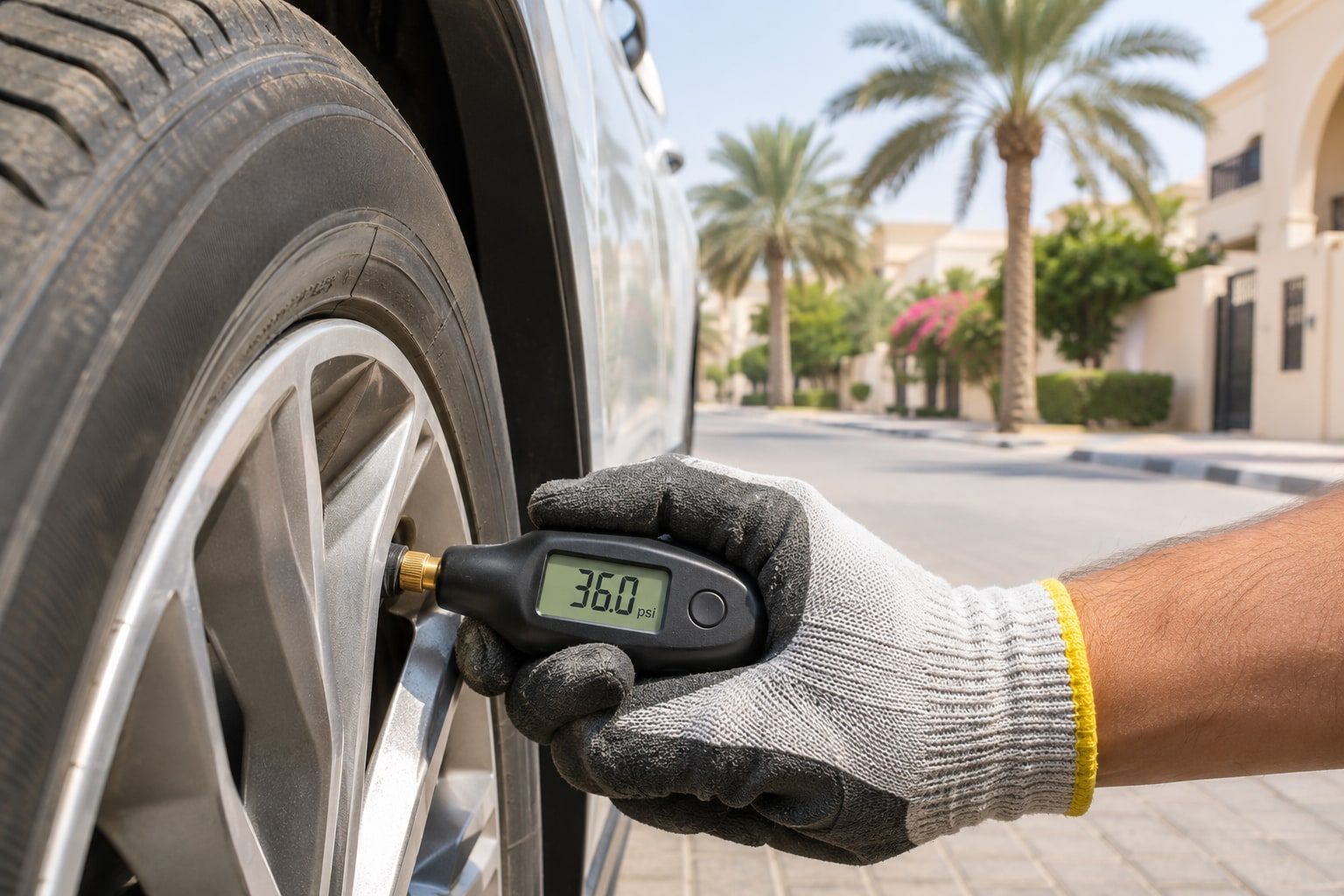
The correct tyre pressure for your car is the cold pressure on the car maker’s placard, usually on the driver’s door jamb, sometimes inside the fuel flap, and always in the handbook. It is not the number moulded on the tyre sidewall, which is the tyre’s maximum.
Getting it right matters more in the UAE than almost anywhere: under-inflated tyres flex and overheat on long, hot motorway runs, and sand trips tempt owners to change pressures that then get forgotten.
Where do you find your car’s recommended pressure?
- Driver’s door jamb or B-pillar (most common)
- Inside the fuel filler flap
- The owner’s handbook, which may list extra sizes and loads
Bridgestone describes the sidewall figure as the maximum permissible pressure for the tyre only, and notes that the car maker’s figure may be lower. Michelin likewise says to use the door-jamb figure.
How do PSI, kPa and bar compare?
One PSI is about 6.9 kPa, and 1 bar is 100 kPa, or about 14.5 PSI. Bridgestone’s own manual pairs 4 psi with 28 kPa, which matches that conversion.
| PSI | kPa | bar |
|---|---|---|
| 30 | 207 | 2.1 |
| 32 | 221 | 2.2 |
| 35 | 241 | 2.4 |
| 38 | 262 | 2.6 |
| 42 | 290 | 2.9 |
When should you check, and what counts as cold?
Check at least monthly and before long trips, with the tyres cold. Bridgestone defines cold as parked for three hours or more, or driven less than about 1.6 km.
Heat raises the reading: Michelin says pressure climbs by about 0.1 bar (1.5 psi) for every 10°C rise. Never let air out of a hot tyre to reach the cold figure, because it will be under-inflated once it cools, a warning both Bridgestone and Pirelli repeat.
Summer routine
Check early in the morning in a shaded car park, before the sun heats the tyres. A reading taken at 3pm on a black tyre in direct sun will mislead you.
Should you change pressure for load?
Yes, if your placard lists a laden figure. Michelin notes that some placards give a standard and a higher loaded pressure; use the higher one for a full car, a roof box or towing, then return to normal.
This matters most on heavy SUVs and pickups, covered in the SUV tyre guide and pickup tyre guide.
What does a TPMS warning mean, and what should you check?
A TPMS light means at least one tyre has dropped well below the placard figure. The US standard FMVSS 138, which many cars are built to, requires the warning when pressure falls 25% or more below placard.
- Slow down and stop safelyPull over where it is safe, away from traffic.
- Look at each tyreCheck for flats, nails or sidewall damage. A steady or flashing light can mean different things; the handbook explains your car’s version.
- Check with a gauge when coldInflate to the placard figure. If the light returns, you probably have a slow leak.
- Light stays on after inflating?The sensor may be faulty or need relearning. Our TPMS sensor service diagnoses it.
A light that keeps coming back usually means a puncture or slow leak worth inspecting.
Deflating for desert driving
Lower pressure helps on soft sand, but it is only for the sand. BFGoodrich warns against deflating without a way to reinflate, and running sand pressure at road speed overheats the tyre.
Our long-drive preparation guide and off-road tyre guide cover the full routine. Uneven shoulder wear is a sign of long-term wrong pressure, shown in wear from wrong pressure.
Want us to check and set your pressures?
A tyre pressure check covers all four tyres and the spare, set cold to your placard, with a look for leaks and damage.
Book a tyre pressure check at your location
Questions
Questions drivers ask
What tyre pressure should my car have?
The figure on your car’s placard, set when the tyres are cold. Different cars, sizes and loads need different pressures, so there is no single correct number.
Should I inflate to the maximum on the sidewall?
No. The sidewall figure is the most the tyre can safely hold, not the pressure for your car. Over-inflation reduces grip and wears the tread centre.
Should I lower my pressure in summer?
No, keep the placard cold pressure all year. The rise in a hot tyre is expected and allowed for; lowering it means under-inflation once the tyre cools.
Why does my TPMS light come on in the morning?
Cooler overnight air lowers pressure, so a tyre that is already slightly low can drop below the warning threshold. Check and top up to the placard figure.
Sources
- Bridgestone: tyre maintenance and safety manual
- Bridgestone: tyre FAQs on checking pressure
- Michelin: recommended pressure and laden figures
- Michelin Malaysia: what tyre pressure to use
- Pirelli: how tyre pressure changes with heat
- 49 CFR 571.138 (FMVSS 138): TPMS
- BFGoodrich: finding the right off-road tyre pressure