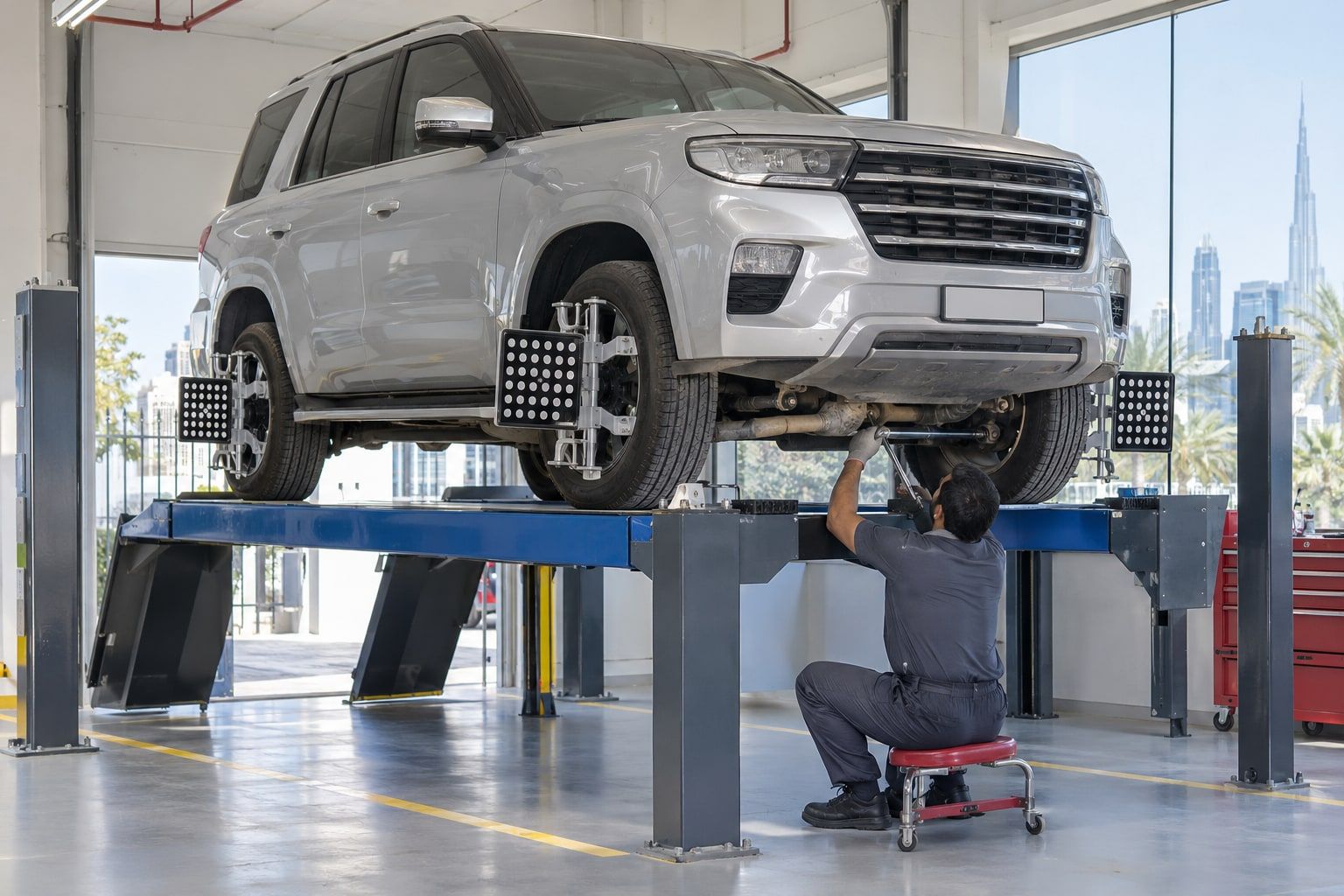
The clearest signs your wheels need aligning are a car that drifts to one side on a straight, level road, a steering wheel that sits off-centre when you drive straight, and tyres wearing on one edge or with feathered tread ribs. Any of these appearing after a kerb or pothole strike is a strong hint the geometry has been knocked out. Alignment needs a level rig, so it is a workshop job.
Ignoring misalignment rarely feels dangerous day to day, but it quietly takes thousands of kilometres off a set of tyres.
What do toe, camber and caster control?
| Angle | What it is | Sign when wrong |
|---|---|---|
| Toe | Wheels pointing in or out, seen from above | Feathered tread ribs |
| Camber | Wheel tilt, seen from the front | Wear on one edge |
| Caster | Steering axis angle, seen from the side | Weak self-centring, drift |
Continental explains that positive caster helps the steering return to centre and keeps the car stable, which is why a caster problem often shows as steering that feels vague or reluctant to straighten.
Which alignment symptoms should you watch for?
- The car drifts left or right on a straight, level road
- The steering wheel logo sits off-centre when driving straight
- Tyres squeal through slow turns in car parks
- One edge of a tyre is wearing faster than the other
- Tread ribs feel feathered when stroked across
- The steering changed after a kerb, pothole or speed-bump strike
Continental lists vibration as a possible sign too, but vibration on its own more often comes from balance; pair it with the other symptoms before blaming alignment.
Could the pull be caused by something other than alignment?
Yes, so rule out the simple causes first. One soft tyre can make a car drift, so check cold pressures against the placard before booking anything; the tyre pressure guide shows how.
Roads are built with a slight slope for drainage, so a gentle drift towards the kerb can be normal; test on a flat stretch. Continental also names worn bushes, shocks and struts as gradual causes, which an alignment alone will not cure.
When should you book a wheel alignment?
- Straight away if the car pulls or the steering wheel is off-centre.
- After a hard kerb, pothole or speed-bump strike; see impact damage.
- When new tyres are fitted, so they start on correct geometry.
- After suspension work, or after lifting or lowering the car.
- Periodically: Continental suggests a check at least once a year.
Workshop only
Wheel alignment is done on a level alignment rig at our Al Quoz, Sharjah or Mussafah workshop. Ask about collection when you book.
What happens to your tyres if you leave it?
A misaligned car wears its tyres on one edge or scrubs the ribs into a saw-tooth, and rotation cannot undo that. The tyre ends up replaced with plenty of tread left in the middle, which is covered in the uneven tyre wear guide.
If the damage is done, align first and then replace; the tyre replacement page explains what to match, and a bent wheel from the same impact can go through rim repair at the workshop.
Describe the pull or send photos of the tyre wear and we will book an alignment check.
Questions
Questions drivers ask
How do I know if my car needs a wheel alignment?
The main signs are a drift on a straight road, an off-centre steering wheel and tyres wearing on one edge. Any of these after an impact makes an alignment check worthwhile.
Is wheel alignment the same as balancing?
No. Alignment sets the angles of the wheels to the car; wheel balancing evens out weight around each wheel to stop vibration. They fix different symptoms.
Can I drive with bad alignment?
A mild misalignment is not an immediate danger, but it wears tyres fast and can make the car tiring to hold straight. A sudden change after an impact should be checked soon, because a bent part may be involved.
Should I get an alignment with new tyres?
It is a sensible time to do it, and Continental recommends it, especially if the old tyres wore unevenly.
Sources