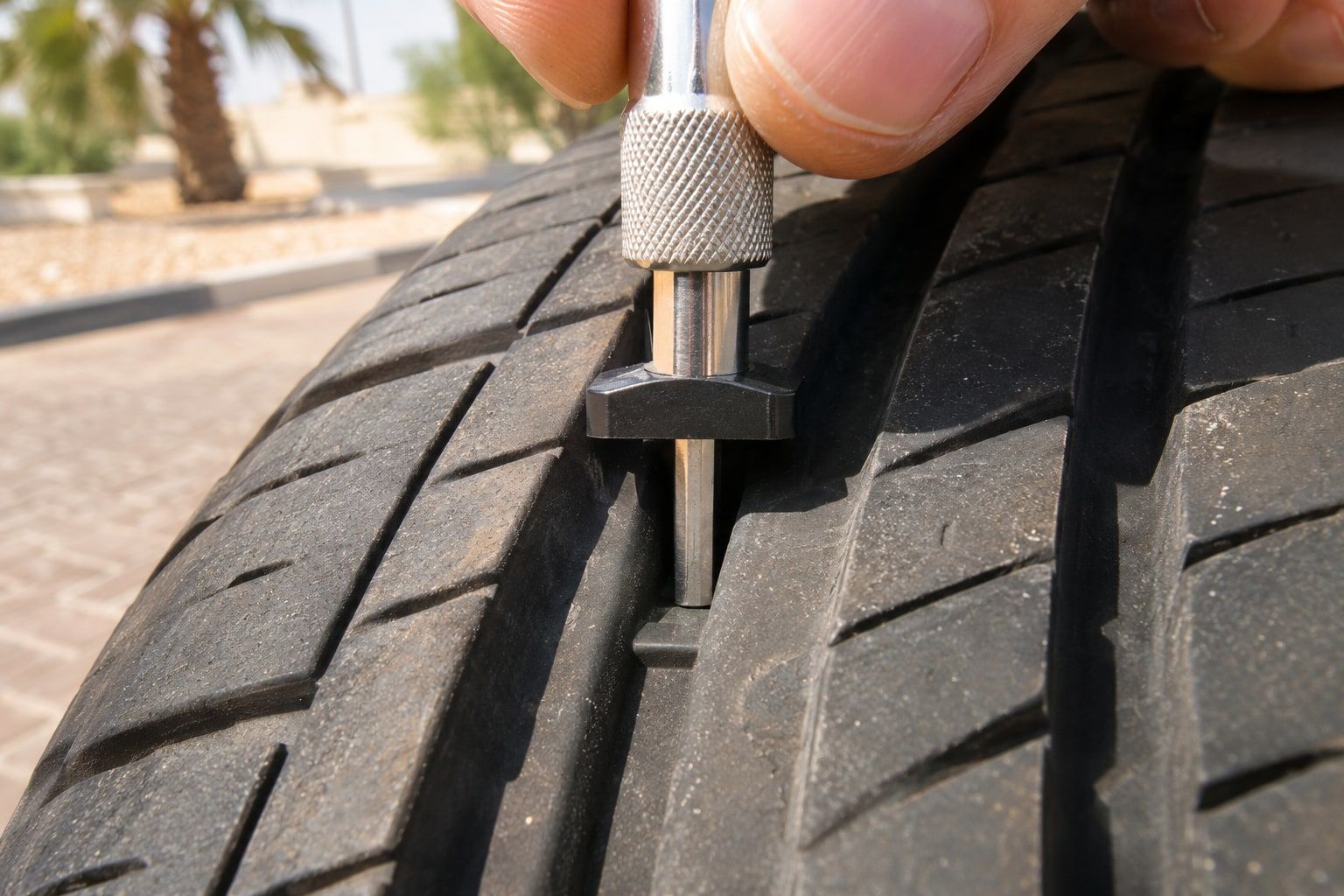
Replace a tyre when its tread reaches the 1.6 mm legal minimum, when it is five years past its manufacture date, or as soon as it shows a bulge, a sidewall cut or deep cracking. Most drivers should plan replacement before the legal limit: TyreSafe notes that 3 mm is the minimum commonly advised by tyre and safety experts, because wet braking distances grow sharply on thinner tread.
This post explains how to check each sign, how the UAE age rule works, how long tyres really last, and whether you need to replace all four at once.
How much tread is too little?
Tread is too little at 1.6 mm, the legal minimum commonly given for the UAE, and worth replacing from about 3 mm. Michelin notes that legislation requires a tyre to be changed when the tread falls below 1.6 mm, and moulds small wear indicator bars into the grooves at that height.
The 3 mm advice comes from braking tests. TyreSafe cites MIRA research in which cars on 1.6 mm tread needed up to 44 percent longer to stop in the wet than cars on 3 mm. Rain is rare here, but the first showers of the season leave Sheikh Zayed Road slick with oil and dust, and that is exactly when worn tyres catch drivers out.
Measure in the main grooves at several points across the tyre, because uneven wear often leaves one edge far lower than the centre. Our tread depth guide shows how to use a gauge or the wear bars.
How old is too old for a tyre in the UAE?
In Dubai, five years from the manufacture date is the limit. The RTA has stated that a tyre’s validity runs five years from its date of manufacture irrespective of use, and that tyres past that age fail the vehicle technical test.
Age counts from the factory, not from fitting, so a tyre that sat in a warehouse for two years has only three left. That is why we show the DOT date before fitting. Michelin’s wider guidance is to have tyres inspected yearly once they reach five years and to replace them after ten years in any case, including the spare.
Fine cracks in the sidewall or between tread blocks deserve a professional look even on a tyre with plenty of tread left. See tyre ageing and cracking for what to look for.
What damage means you should replace a tyre now?
Any damage to the structure means immediate replacement: bulges, sidewall cuts, exposed cords and punctures outside the central tread. A bulge means the internal cords have broken, and the tyre can fail without warning.
- A bulge or blister on the sidewall, often after a kerb or pothole strike
- A cut deep enough to show cords
- A puncture in the shoulder or sidewall, or larger than about 6 mm
- A tyre driven flat, which must be inspected from inside before any repair is considered
A puncture in the central tread can often be fixed with a plug-and-patch repair from inside. Book a puncture repair and the technician will tell you which side of the line your tyre falls.
How long is the life of a tyre?
There is no fixed answer: Michelin says it is impossible to predict exactly how long a tyre will last, because design, driving style, climate, roads and maintenance all play a part. In practice the tyre ends its life at whichever comes first: the tread limit, the age limit or damage.
Michelin lists wrong pressures and impacts with kerbs, holes and speed bumps among the things that shorten tyre life. A common case is a car used mainly on short city trips whose tyres reach five years old with tread to spare, while a high-mileage commuter on the E311 wears through a set long before that. Our post on whether tyres can last 60,000 km looks at mileage in more detail.
Do you have to replace all four tyres at once?
No, but replace at least the pair on one axle so left and right match. When only two are new, Continental notes that the tyre industry recommends fitting the new pair on the rear axle for stability.
All-wheel-drive and 4x4 cars are stricter, and some makers set limits on the tread difference allowed between tyres. Check the handbook, and see our post on replacing tyres on AWD and 4x4 cars.
A quick replacement checklist
- Tread at 3 mm or less in any main groove: plan replacement
- Tread at the wear bars (1.6 mm): replace now
- DOT date five years old or more: replace before your next inspection
- Bulge, sidewall cut or exposed cords: replace now
- Fine cracking on an older tyre: have it inspected
If any box is ticked, send us a photo of the tyre and its DOT code and we will confirm whether it needs replacing. Our tyre replacement service covers choosing and fitting the new set.
Send a photo of your tread and DOT code and we will tell you whether your tyres are due.
Questions
Questions drivers ask
How long is the life of a tyre?
It depends on mileage, driving style, roads and care, so there is no single figure. In Dubai the practical maximum is five years from manufacture, since older tyres fail the technical test. Many high-mileage drivers wear through the tread well before that.
Is a five-year-old tyre safe if the tread is good?
It may still be sound, but in Dubai it will fail the vehicle technical test once it is five years past its DOT date. Have it inspected and plan to replace it before your next renewal.
At what tread depth should I replace my tyres?
The legal minimum is commonly given as 1.6 mm, but tyre and safety experts commonly advise replacing at 3 mm. Below that, wet braking distances increase sharply.
Can I replace just one tyre?
You can if the other tyre on that axle has very similar tread depth and you fit the same model. Otherwise replace the pair. On AWD cars, check the handbook for tread-difference limits.
Do spare tyres expire?
Yes. A spare ages from its manufacture date like any other tyre, even if it has never touched the road. Check its DOT code when you check the others.
Sources