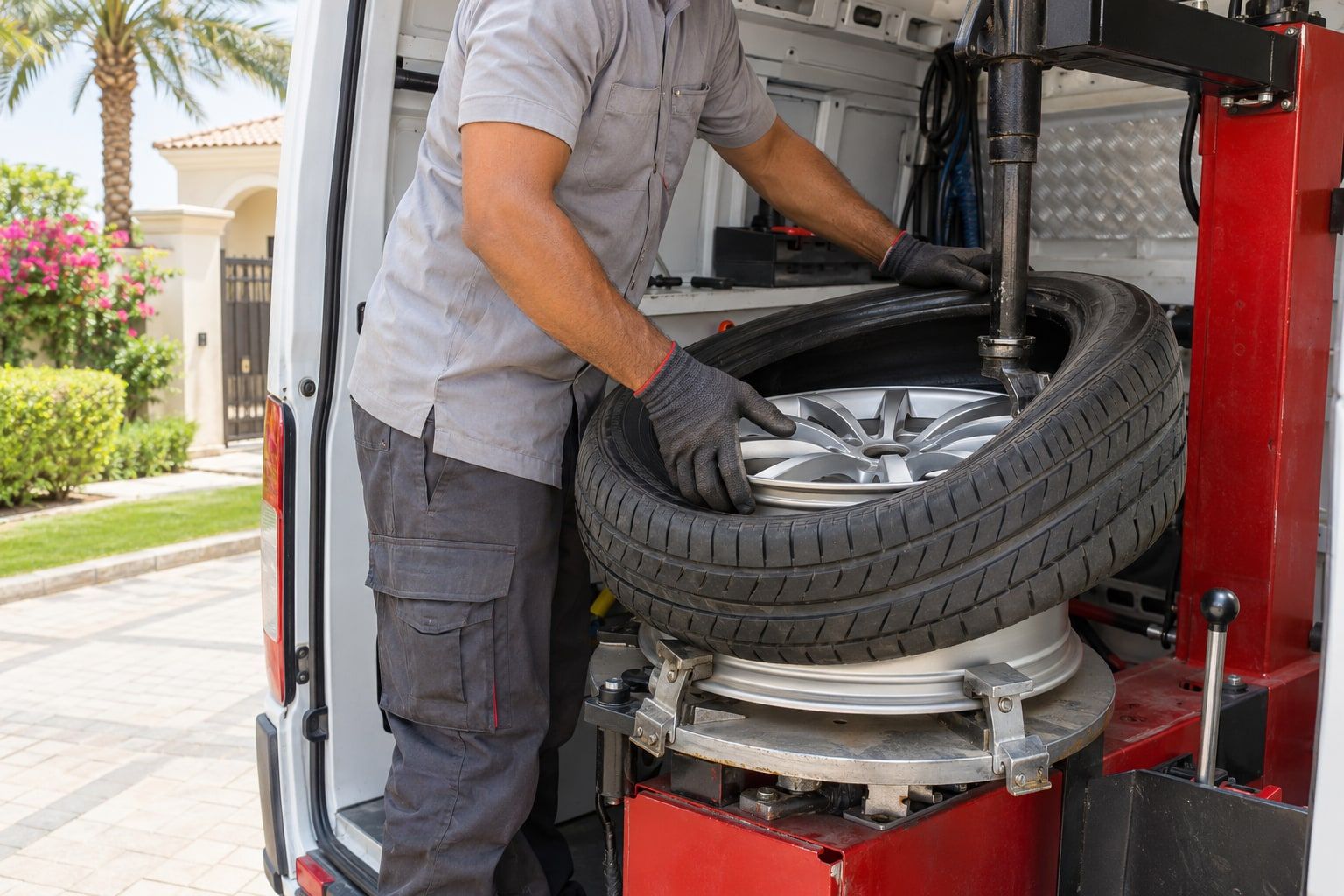
Tyre rotation moves each wheel to a different corner so all four wear at a similar rate. Follow the interval in your vehicle handbook first; where it gives none, Michelin’s standard advice is every 5,000 to 7,000 miles (roughly 8,000 to 11,000 km) and Bridgestone’s is every 5,000 miles. Directional tyres only move front to rear on the same side, and cars with different front and rear sizes may not allow rotation at all.
Rotation is a small job that pays back over the life of a set, especially on cars where the front tyres do the steering, most of the braking and, on front-wheel drive, the driving too.
Which rotation pattern does your car need?
| Car or tyre | Pattern |
|---|---|
| Front-wheel drive | Fronts straight back, rears cross forward |
| Rear-wheel drive | Rears straight forward, fronts cross back |
| AWD or 4x4 | X pattern, unless the handbook says otherwise |
| Directional tyres | Front to rear on the same side only |
| Staggered sizes | Often no rotation possible |
Michelin notes that all-wheel and four-wheel drive cars usually need rotating more often; see replacing tyres on AWD and 4x4 cars for how matched wear affects those drivetrains.
How do directional and staggered tyres limit rotation?
A directional tyre has an arrow on the sidewall showing which way it must roll, so it can only swap between front and rear on the same side. Bridgestone states this applies whatever car the tyres are on.
A staggered set, with wider tyres at the rear, cannot move front to rear because the sizes differ. Michelin says some staggered fitments may not allow rotation at all, so plan to replace those tyres by axle as each pair wears out.
Can you rotate tyres at home, or is a fitter better?
At home
- Needs a proper jack and axle stands
- Wheel nuts must be torqued to the maker figure
- No balance check or tyre inspection
Mobile or workshop
- Wheels inspected off the car
- Balance checked if there is vibration
- Pressures reset front and rear to the placard
If your car displays pressures by wheel position, the readings may need resetting after a swap; the handbook explains how, and TPMS sensor service can help if the warning will not clear.
When is rotation the wrong fix?
Correct the cause first
If a tyre is worn on one edge or feathered, the car probably needs a wheel alignment. Rotating it only moves the damage to a new corner, and the replacement tyre will wear the same way.
Rotation also cannot rescue a tyre already near the wear bars; check depths first with the tread depth guide.
What should be checked during a rotation?
- Tread depth on every groove before the wheels move
- Sidewalls and inner faces for cuts, bulges and cracks
- Cold pressures reset front and rear, which often differ
- Wheel nuts torqued in sequence to the maker figure
- Balance checked if the car vibrated at speed
- Spare tyre pressure and DOT date
Book tyre rotation as a mobile job, and add wheel balancing if you have felt a shimmy through the steering.
Tell us your car and mileage since the last rotation and we will book a rotation.
Questions
Questions drivers ask
How often should tyres be rotated?
Follow your vehicle handbook. Where it is silent, Michelin suggests every 5,000 to 7,000 miles (about 8,000 to 11,000 km) and Bridgestone every 5,000 miles.
Can directional tyres be rotated?
Yes, but only front to rear on the same side of the car. Crossing them would make them roll against the arrow on the sidewall.
Should the spare be included in rotation?
Only if it is a full-size spare of the same make, size and condition, and the handbook allows it. A space-saver spare is never part of a rotation.
Does rotation need a wheel balance?
Not every time, because each wheel keeps its own balance weights. Rebalance if you feel vibration after the swap or the tyres have worn unevenly.
Sources