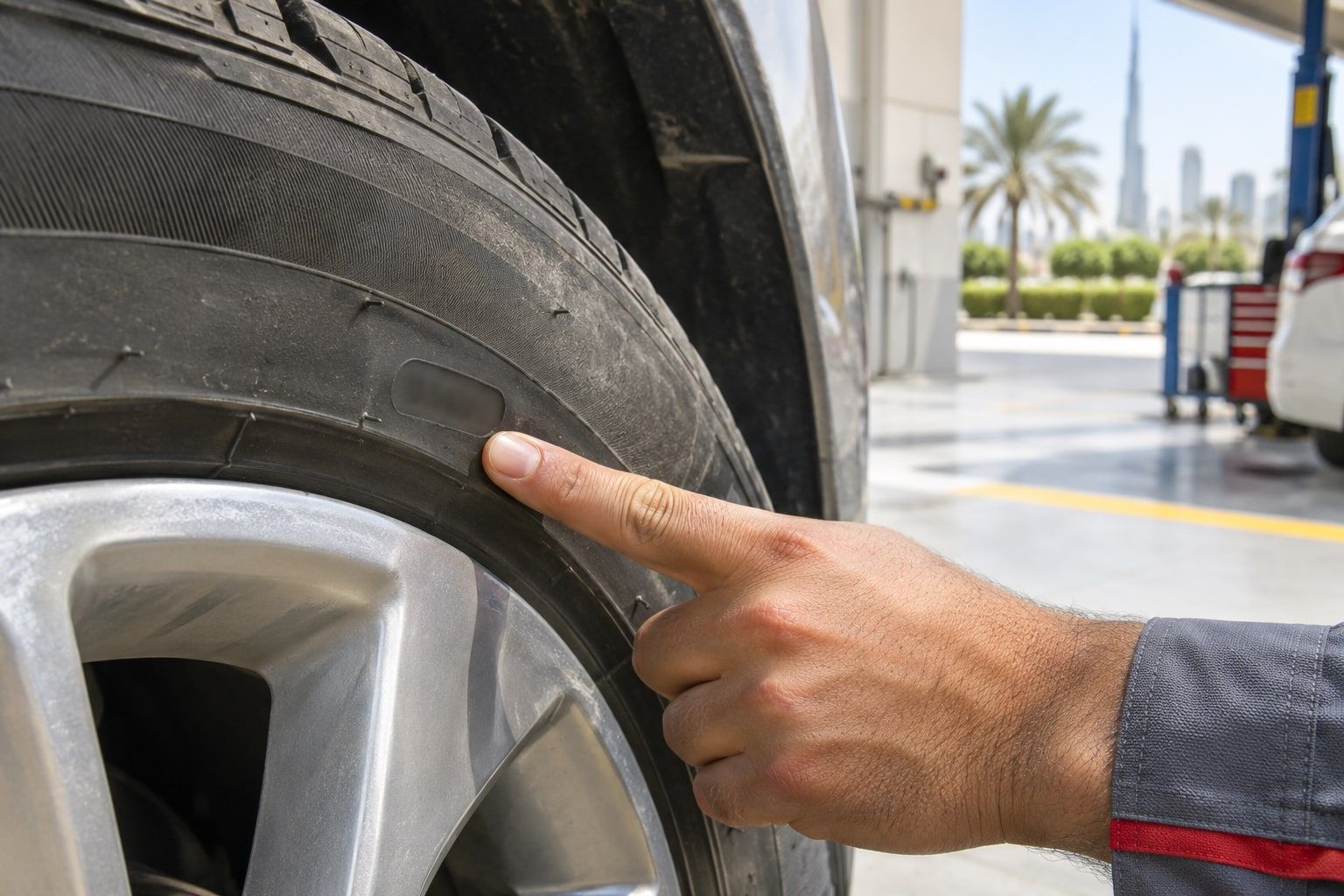
A tyre bulge is a blister on the sidewall where the cords inside the casing have broken and air is pushing the outer rubber outwards. It cannot be repaired, and the tyre should be replaced before any more motorway driving because the weakened spot can fail suddenly. The usual trigger is a hard hit: a kerb, a pothole, or a speed bump taken too quickly.
The decision afterwards is mostly about matching. One new tyre can be enough if the other tyre on that axle is in good shape, but a worn partner or an all-wheel-drive car can make a pair the better buy.
How do you tell a bulge from a harmless sidewall dent?
A bulge sticks out; a dent sinks in. Continental describes shallow sidewall indentations as a by-product of how the casing plies overlap during manufacture, and says they do not affect safety, whereas an outward bulge signals destroyed cords.
Bulge: replace
- Raised, rounded lump
- Often appears after an impact
- May grow over days
- Firm when pressed
Indentation: usually harmless
- Narrow vertical dip
- Present since the tyre was new
- Often several, evenly spaced
- Does not change over time
If you cannot tell which one you have, treat it as a bulge until a technician has looked at it.
What does a tyre bulge look and feel like from the driver’s seat?
- An egg-shaped lump on the outer or inner sidewall
- A lump that only shows on the front inner face with the steering on full lock
- A new thump once per wheel turn at low speed
- A shimmy or vibration that was not there before a pothole or kerb strike
- A scrape or rim mark close to the lump
The inner sidewall is easy to miss, so after any hard hit turn the steering fully each way and look behind the front tyres with a phone torch.
Can you drive on a tyre with a bulge?
Only as far as a safe place to change it, and slowly. The cords that hold the tyre’s shape have already failed in that spot, and heat and speed load them further.
Do not use a bulged tyre on the motorway
Fit the spare, or book flat tyre assistance if the spare is missing or flat. A long run on Sheikh Zayed Road or the E311 at summer temperatures is the worst case for a weakened casing.
If your spare is a space-saver, keep to its marked speed limit and swap back to a full-size tyre soon; our spare tyre fitting service can do the change where the car is parked.
Why did the bulge appear, and does the wheel need checking too?
Continental links sidewall bulges to running over kerbs or speed bumps, and says the size of the damage depends on speed, angle and the obstacle. Low-profile tyres leave less rubber between the rim and the road, so they are more exposed on a hard edge; see bigger wheels and what changes.
An impact strong enough to break cords can also bend the rim lip or knock the alignment. Ask the fitter to check the wheel for run-out while the tyre is off, and read the impact damage guide for the other signs to look for.
Should you replace one tyre or both on that axle?
| Situation | Usual choice |
|---|---|
| Partner tyre nearly new, same model available | One tyre |
| Partner tyre well worn | A pair |
| Same model no longer made | A pair |
| AWD or 4x4 with tread-difference limits | Check the handbook; often a pair or four |
All-wheel-drive systems can be sensitive to mismatched tyre diameters, which is covered in replacing tyres on AWD and 4x4 cars. For the size and rating itself, start from tyres by car or the tyre replacement service.
Send a sidewall photo of the bulged tyre and we will quote a matching replacement.
Questions
Questions drivers ask
Can a tyre bulge be repaired?
No. Michelin states that sidewall bulges always require replacement, because the damage is to the internal structure rather than the surface rubber.
Will a bulge go down if I lower the pressure?
No, and running the tyre softer makes the sidewall flex more, which stresses the damaged area further. Keep the placard pressure and replace the tyre.
Is a bulge on the inner sidewall less serious?
It is just as serious; it is only harder to see. The cords are broken either way, so the tyre needs replacing.
Can a brand-new tyre have a bulge?
A new tyre can be damaged by an impact on its first day, and rarely a bulge comes from a manufacturing fault. Either way it needs inspecting, and the decision on cause is made by the technician or the tyre maker.
Sources