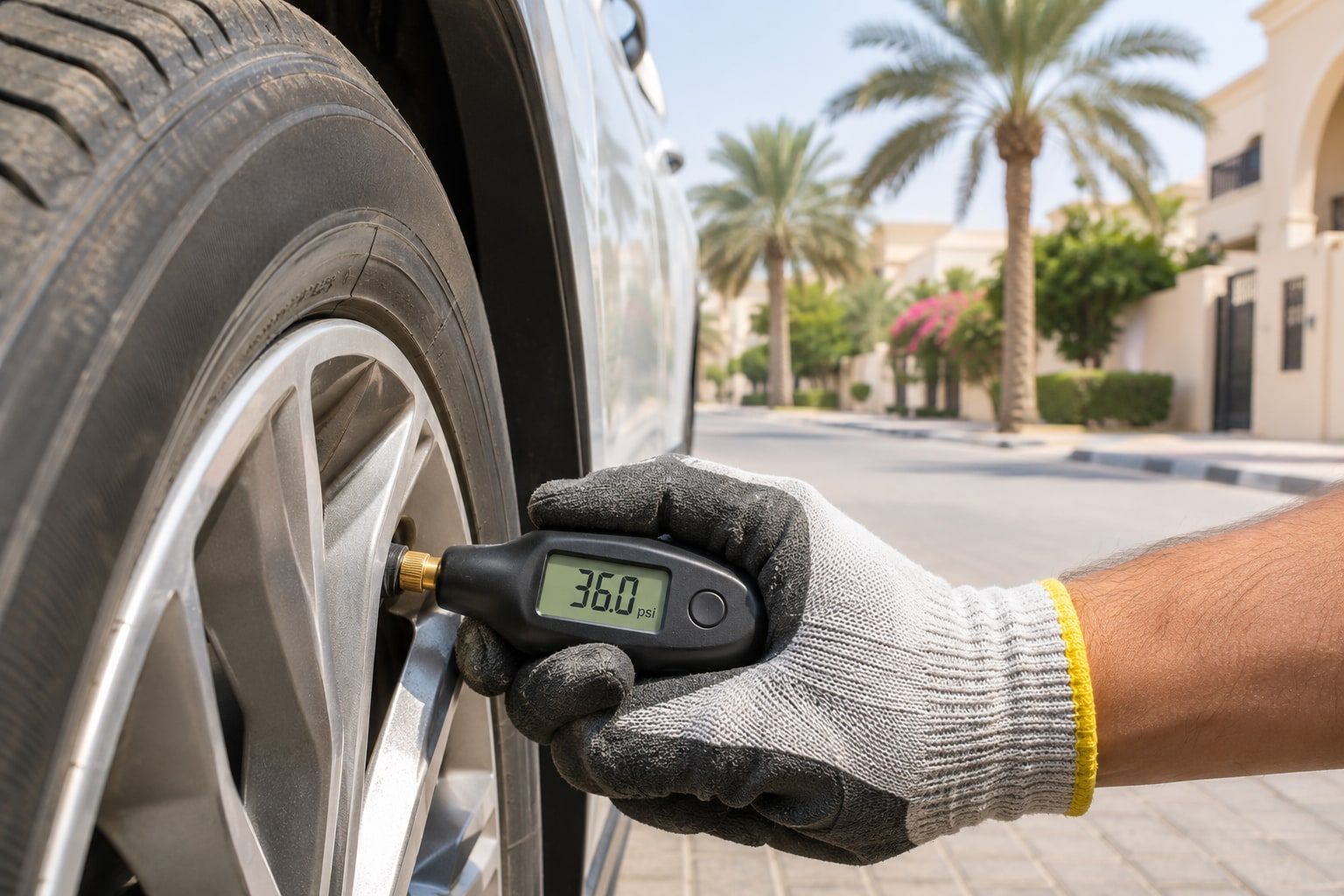
Running tyres too soft wears both shoulders and makes them run hotter; running them too hard wears a strip down the centre. The fix starts with the cold pressure on your car’s placard, not the maximum printed on the tyre’s sidewall. If the wear has already reached the tread wear indicators anywhere across the tyre, it needs replacing.
Pressure is the cheapest thing on a car to get right and the most common reason for tyres wearing out early. Many UAE drivers top up at a fuel station after a hot drive, which gives a misleading reading.
Soft or hard: which pattern is on your tyres?
Under-inflated
- Both outer edges worn, centre still deep
- Rounded-looking shoulders
- Sluggish, vague steering
- More heat and higher fuel use
Over-inflated
- Centre strip worn, edges deeper
- Harsh ride over expansion joints
- Load concentrated on the middle of the contact patch
- More jolt through speed bumps
Michelin links both-shoulder wear to under-inflation and centre wear to over-inflation, and adds that an under-inflated tyre runs warmer, wears faster and raises fuel consumption. Wear on one edge only is a different problem, covered in uneven tyre wear.
Where is the right pressure for your car?
The correct figure is on the placard in the driver’s door jamb, inside the fuel flap or in the handbook, and it is a cold pressure. Michelin notes many placards give a higher loaded figure for a full car or heavy luggage; the sidewall number is the tyre’s maximum, not a target.
Why does checking pressure in UAE heat need care?
Driving warms the air inside a tyre and raises its pressure, so a reading taken after a drive looks higher than the true cold figure. Michelin’s Middle East advice is to check after less than 2 km of driving and not to let air out of warm tyres to match the placard.
- Check earlyMeasure before the first drive of the day, or after the car has stood in shade.
- Use your own gaugeA pocket gauge gives a consistent reading; forecourt gauges vary.
- Set to the placardAdjust each tyre, front and rear separately, and include the spare.
- Recheck in a weekA tyre that keeps dropping has a leak, so book an inspection rather than topping up forever.
The tyre pressure guide explains PSI and kPa, and a tyre pressure check can be added to any mobile visit.
Is a tyre worn by wrong pressure still safe to use?
If the most worn shoulder or centre strip is still above the wear indicators and there is no other damage, the tyre can stay on once the pressure is corrected. A tyre that has been run very soft for a long time is different: Michelin warns that low-pressure running can damage the casing from inside.
Have it inspected if
the tyre was driven noticeably flat, the shoulders show cracking or a dark band of scuffed rubber around the sidewall, or the TPMS light has been on for weeks. Under US rules the warning is set to trigger at about 25% below placard, so a lit light already means a big loss.
What should you replace, and what should change in your routine?
- Replace any tyre worn to the indicators on either shoulder or the centre.
- Replace in axle pairs where the partner tyre shows the same wear.
- Fix a recurring low tyre at the source: a puncture, valve or rim seal.
- If the TPMS light is unreliable, have the sensors checked through TPMS sensor service.
- Check cold pressures monthly, and before long trips.
When you do replace, the tyres by car finder shows sizes for your model and the tyre replacement page explains what fitting includes.
Questions
Questions drivers ask
Should I use the pressure written on the tyre?
No. The figure moulded on the sidewall is the maximum the tyre can hold. Use the cold pressure on your car’s placard or in the handbook.
Should I let air out when tyres are hot in summer?
No. Pressure rises as a tyre warms up, and releasing air leaves it under-inflated once it cools. Michelin advises rechecking once the tyres are cold.
How often should I check tyre pressure?
Michelin recommends once a month with the tyres cold, plus before a long drive. Include the spare.
Sources