Fitting & cost · 6 min read
How to check new tyre quality when your tyres are fitted
To check new tyre quality, confirm the DOT date is recent, the size, load index and speed rating match your placard, both tyres on each axle are identical, and the tyres are free of storage damage before they go on the rim. After fitting, check that each wheel was balanced, the pressures were set cold to the placard figure and the wheel nuts are rechecked after the first 50 km.
Most of this takes a minute while the technician works. It is your money and your car, and a good fitter will happily show you each point.
What should you check before the tyre goes on?
- The DOT date code on each tyre, and that both tyres on an axle are from a similar batch.
- Size, load index and speed symbol against your door placard or current tyres.
- Any special marking your car needs: XL, run-flat, an OE code or an EV marking.
- No cuts, cracks, flattened beads or deformation from poor storage.
- Direction arrows or “outside” markings, so the tyre is mounted the right way round.
How do you read the DOT date on a new tyre?
The last four digits of the DOT code give the week and year of manufacture, as set out in the US federal rule that defines the code. A tyre stamped 3826 was made in the 38th week of 2026.
Age matters more in the UAE than in many markets. The RTA has said a vehicle will not pass its technical test if the tyres are more than five years past their manufacture date, so a tyre that spent two years in a warehouse has already used two of those five. Every tyre we supply is new stock, and the technician shows you its DOT code before mounting it.
Does the tyre match what you ordered?
| Marking | Check against | Why it matters |
|---|---|---|
| Size, e.g. 235/55 R19 | Placard or old tyre | Fit, speedometer, AWD |
| Load index | Placard minimum | Carrying capacity |
| Speed symbol | Placard minimum | Heat and speed capacity |
| XL or run-flat | What the car had | Pressure and spare-wheel needs |
| OE code (★, MO, N0) | Your current tyres | Maker-tuned version |
If any rating is lower than the placard, stop the job. Michelin’s guidance is that a replacement must carry an equivalent or higher load rating than the vehicle specifies.
What should happen during fitting?
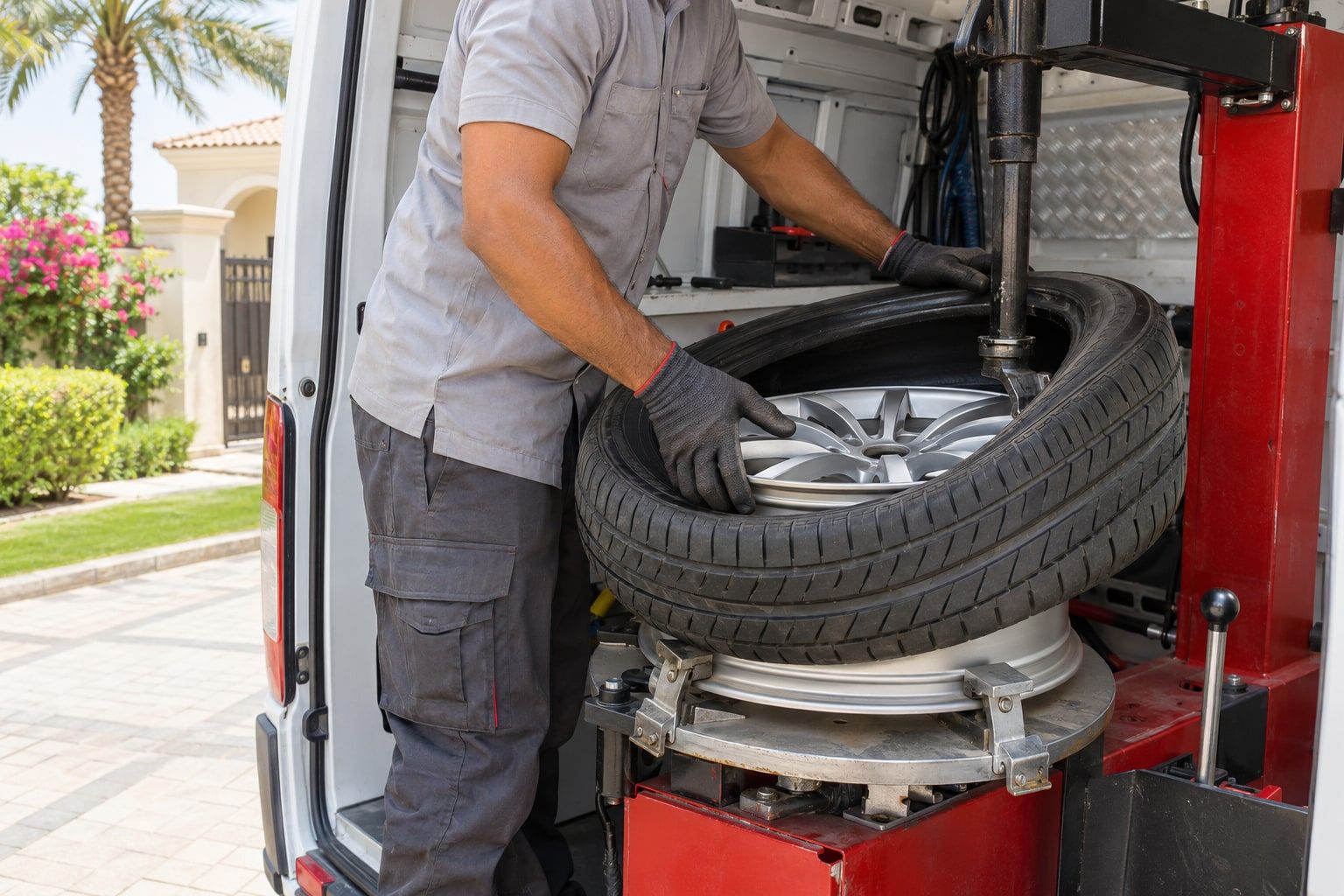
- Old tyre off, rim checkedThe bead seat is inspected for corrosion or damage that could cause a slow leak.
- New valveA new rubber valve is fitted; TPMS valves are serviced rather than replaced unless worn.
- Mount and inflateThe tyre is mounted, seated and set to the cold placard pressure, not the sidewall maximum.
- Balance each wheelEvery fitted wheel is dynamically balanced. Ask to see the balancer read zero after the weights go on.
- Torque the nutsWheel nuts are tightened to the vehicle maker’s figure with a torque wrench, in a star pattern.
This is what our tyre change and fitting service includes on every job, at home or in the workshop.
Two extra points apply to some cars. Run-flat tyres have stiff sidewalls, so ask how the fitter handles them before the job starts. On cars with tyre pressure sensors, the warning light should go out after a short drive; if it stays on, our TPMS sensor service can diagnose it.
What should you check in the first 50 km?
Continental advises having the wheel nuts retorqued after the first 50 km on new tyres, because wheels can settle. Ask us to recheck them, or have a workshop with a torque wrench do it.
Watch for a vibration through the steering at motorway speed, which points to balancing, or a steady pull to one side, which may need wheel alignment. Recheck pressures cold the next morning; a tyre that has dropped noticeably overnight needs a look at the valve or bead.
Book fitting and we will show you the DOT date and ratings before the first tyre goes on.
The verdict: four checks that matter most
A recent DOT date, ratings that meet the placard, a matched pair per axle and balanced wheels with torqued nuts. If those four are right, the tyre will perform as its maker intended. To choose the tyre itself first, start with new tyres.
Questions
Questions drivers ask
How old can a new tyre be?
There is no universal shelf-life figure, but in the UAE the five-year limit runs from the manufacture date, not the fitting date. A recent DOT date gives you the most usable life.
Should new tyres be set to the pressure on the sidewall?
No. The sidewall figure is the maximum the tyre can hold. Set the cold pressure shown on the vehicle placard.
Why does my car vibrate after new tyres?
The usual cause is a wheel that needs rebalancing or a weight that has come off. A pull to one side is more often alignment.
Do wheel nuts really need rechecking?
Continental recommends a retorque after the first 50 km on new tyres. It is a quick check with a torque wrench.
Can you fit tyres I bought elsewhere?
Yes, if they are the right size for your car and in new condition. We check the DOT date and markings before fitting.
Sources